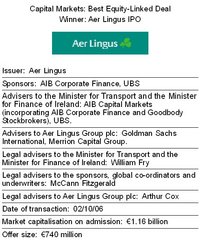
Aer Lingus finally came to the market in October 2006, following years of 'will they, won't they' speculation. The deal was the first privatisation of an Irish company since eircom in 1999 and the first listing on the Irish Stock Exchange in over two years. Aer Lingus also listed on the London Stock Exchange, and was the first airline to be brought to market in the UK and Ireland following the flotation of Easyjet six years ago. Dermot Mannion, as CEO of Aer Lingus, was the man who made it finally happen.
The company went public on October 2nd, 2006, with an offering value of E740 million, and the company's valuation on flotation was E1.2 billion. The offer share price was E2.20. On April 17th, the price stood at E3.15, representing growth of 43 per cent since its flotation.
AIB Capital Markets (incorporating AIB Corporate Finance and Goodbody Stockbrokers) acted as global co-ordinators, bookrunners and financial advisers to the Minister for Transport and the Minister for Finance of Ireland, while Goldman Sachs and Merrion Capital advised Aer Lingus. On the legal side, Arthur Cox advised Aer Lingus, while McCann Fitzgerald gave advice to the sponsors of the deal, and William Fry advised the Government.
Alan Doherty, managing director of AIB Corporate Finance, said that there were numerous obstacles on the path to flotation, not least of which being the cyclicality and unattractiveness of the airline industry for investors. ' It is acutely sensitive to external factors beyond its control: political unrest, economic instability and military warfare; its track record has also been somewhat chequered,' he said.
Dan Ennis, a director at Merrion Capital echoed Doherty's comments. He said, 'The mixture of political and public policy interests together with commercial and market demands made for a highly challenging deal process. The IPO was further complicated by a relatively tight timeframe, an Intermediaries Offering, and a difficult market backdrop due to a high profile local competitor and record oil prices. In addition, the company had to address a number of staff issues, including pensions and a 14.9 per cent shareholding owned by a staff ownership scheme (ESOT)'.
However, he also said that the IPO was a great success for the company, as it provided it with access to capital markets and raising over E500 million in new equity which will be used to fund its future growth plans.
'The deal also a great success for the Irish Government as it allowed it to fulfill its policy of privatising Aer Lingus, thus enabling the company to fund itself for strategic growth now and in the future without recourse to public money. It also enabled the Government to realise part of the value of its shareholding, while retaining a strategic stake,' he added.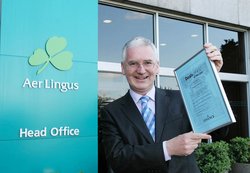 | | Dermot Mannion, chief executive of Aer Lingus |
Doherty says that the IPO was preceded, 'by one of the best restructuring stories in the airline industry; one which transformed the company into a low-cost, low-fares airline'.
'The company was well-positioned and represented an all-important opportunity to invest in a growth story rather than a less appealing turnaround story. With a proven financial track record behind it, the investment case before investors was compelling. Aer Lingus had a business model designed to compete with the vagaries of a fiercely competitive market, strong brand recognition, a strong presence in the growing Irish market, and was well positioned to benefit from transatlantic air liberalisation,' he said.
Eugene McCague, chairman of Arthur Cox who advised Aer Lingus, was pleased to have been involved in the transaction. He said, 'Having acted for Aer Lingus for many years, it was great to be involved in this transaction which provided the company with the funds to enable the management team to execute its ambitious growth plans for the company'.
Of course Aer Lingus going public was not the end of the story - Ryanair quickly saw the opportunity to acquire its closest competitor in the Irish market and began accumulating shares in the company. On October 5th, with a 19.2 per cent share in Aer Lingus, Ryanair made a formal offer of E2.80 per share for the company. It was rejected by both Aer Lingus management and the Government also refused to sell its 28 per cent share on the grounds that it would, 'create a monopoly in the aviation sector in this country'. By November 29th the rival airline had increased its stake in Aer Lingus to 25.2 per cent, but Aer Lingus refused to sell.
Although Ryanair has maintained its commitment to buying the airline at some stage, there is another obstacle facing Ryanair - the European Commission is currently examining the proposed acquisition on competition grounds and is expected to make a decision by June 13th. |