|
|
Saturday, 3rd October 2026 |
| Diversification reflected in Finance Dublin Deals of the Year Awards 2026 |
|
| |
Deals are events that liberate huge incipient energies inherent in the corporate stories that they mark.
A successful deal is one that actually happens. Many don’t happen, and many often fall just at the moment of potential execution. There will always be reasons for that. There are always good reasons for deals to happen as well.
That will usually be (except for bad fortune) because they bring mutual benefits to all sides - if it’s a merger to the parties, if it’s a funding, if its a new business that needs to comply with regulatory guidelines, the net outcome is a zero plus game result. Deals that are zero sum usually don’t work out.
This ‘zero plus’ approach is one of the key principles underlying the judging criteria in the Finance Dublin Deals of the Year Awards in this edition.
Its one of several, the others including innovation, and good business, contributing to sustainable energy solutions, and housing provision, for example. 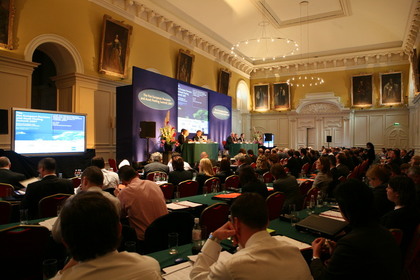 | | Finance Dublin's conference on the Common Contractual Fund and Pension Pooling in the Royal Hospital Kilmainham, Dublin on 16th October 2007. Interest in the tax transparent CCF structure has been growing in recent years with new issuers entering the market. |
One of the unique features of the Finance Dublin deals awards is that they cover transactions within Ireland’s money and capital markets, with a special focus also on the role of the financial services industry in its myriad forms, be they in banking, or in capital and debt markets activity.
The particular award categories are flexible too, to help identify the emergence of new categories of product, and indeed sector. This has resulted in a steady growth in the scope of activities covered during the 20 plus years of the awards. They have therefore reflected the huge evolution and growth of Ireland’s financial services industry.
The 2026 Deals Awards are of record size. There are 69 deals awarded this year. At the same time the ratio of deals to nominations has remained broadly constant however, ensuring there is not an element of ‘award creep’. Thus, the scale of the deals broadly reflects the growth of the market, the number of players, and the economy they exist in.
They have also reflected the evolution of the taxation and corporate finance framework over the years. “Inversions” for example were a strong feature of the deals a decade ago; they have now disappeared, in line with new perceptions around the view that what may be perceived as largely tax driven structures are less preferable than those of demonstrably pure economic substance.
The equity capital markets part of the deals have been less subdued than the Debt Capital markets and Loans & Financing, reflecting the history of Ireland’s capital markets.
This is despite the long history of a public equity market in Ireland, the Irish Stock Exchange, having a proud history going back to 1793 and some more recent years of significant activity, 2017, seeing its last record total for IPOs of €4.2bn. The relative sluggishness of public equity - a global phenomenon - may be ending, however. The EU has set capital markets reform as a top priority for its term, the SIU and Draghi reports being emblematic of that. The declaration by the EU and Ireland that ‘Competitiveness’ should be part of the objectives of the incoming Irish EU Presidency also chimes with that.
For decades public equity has been declining as a percentage of total wealth in America. Earlier this year that trend reversed, mostly reflecting fundraising to fund AI investment. The spectacular launch of SpaceX this month was another public equity impetus (See, Glossary, page opposite) on its “Greenshoe” activation that saw it raise $85.7 billion in its June 12th 2026 IPO. If public markets get traction elsewhere in Europe, for example, the future story may be different. The pattern is continuing.
This concept of ‘good business’ informs the Deals Awards criteria. Ten years ago the Awards were dominated by the rebuilding process then underway as a result of Ireland’s banking and mortgage market collapse the shocking result of system failure, a part of the Irish chapter of the Global Financial crisis of 2007-8. The transition and rebuild after that was a long and difficult, but purposeful story that was tracked in these awards through those years, and which still have echoes in this year’s Awards still.
There are now few remnants of that - the Government’s three stage selldown and exit from its equity stake in AIB an awarded deal this year (page 30) being an example.
ESG and green sustainable finance has been another enduring theme of the awards As is increasing evident from the awards patterns in recent years there is now a large embedded green corporate finance community in Ireland’s dealmaking ecosystem, evident indeed in the deal profiles in this edition.
Corporate finance expertise and the ability such expertise brings to innovate, and take advantage of and apply techniques that have been tried and tested has always been another feature of the awards.
The “off the market” €1.4bn acquisition of Dalata hotel group is such a deal, representing the success of an original approach, a deal that furthermore involved many different participants. Indeed the acquisition merited two deal awards, reflecting the different stories involved - the execution of the deal itself and the financing. (pages 20 and 32).
Excellence in Loans and Financing are also recognised as Irish banks have grown in capability and spread, alongside the corporate banking institutions such as BNP, Danske, Citi whose embedded presence in the Irish corporate dealmaking economy is evident across the Deals Profiles in this edition.
Digitalisation is a feature of financial services increasingly, and this is evident - the Citi Tokenised service deal on page 28 for example.
The Financial Services categories in the annual deal awards is a unique feature that enables the awards to highlight an important dimension of the Irish finance and financial services industry. It does so by identifying financial services businesses (corporate) and structures, such as regulatory wrappers, some of which are unique to the jurisdiction if Ireland. An example is this year’s recognition of the use of an Irish CCF developed by the Irish Government to encourage pensions pooling in Ireland, and which was the subject of a conference held by Finance Dublin in the Royal Hospital Kilmainham (see photo and story on page 28). Interest in the tax transparent CCF structure has been growing in recent years with new issuers entering the market. |
|
|
|



