| The Irish Constitution and the banking crisis |
|
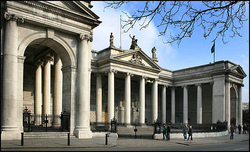
A proposal has been made that Bank of Ireland should make the old Irish Parliament building on Dublin's College Green available to the Government for civic use. There is something to commend this. Its usage as a retail banking branch has for long been beneath the status that its architectural merit and location in the heart of the capital warrants.
It has been suggested that it should be donated, (perhaps as a gesture of abasement to Irish taxpayers for their help in recapitalising the bank), or perhaps at a below market price that contributed to the task of rebuilding the balance sheet of the bank.
The potential symbolism of this could be huge, but, in reality, only if the use to which it was put by a future Irish Government would match the status of the building itself.
The proposal below does this, and furthermore, might go to the heart of an issue that sometimes has been, mistakenly, blamed for the events leading to Ireland's banking, and fiscal crisis.
That is that the failure in political governance has been due in part to inefficiency of Government, blamed in turn on imagined deficiencies in the Constitution, such as the existence of the Senate. A proposal from Fine Gael before the election to hold a referendum to abolish the Senate is an example of this.
By this stage it is clear that the Constitution, and the Senate are very far down the list of causes of the crisis. This is clear from the various official reports published on the crisis, both in Ireland, for example, the Regling-Watson, and Nyberg reports, and overseas, including the US’s FCIC.
Some of the key events in the Irish banking collapse - notably the decision to guarantee the entire balance sheets of the domestic banks was characterised by excessive centralisation of power in very few hands, acting behind closed doors, with little or no accountability to Parliament, and with few if any of the checks and balances that more elaborate, and perhaps, sophisticated legislatures have. It is worthwhile, for example, to compare these events with what happened, in reverse, in the United States. The executive White House) was also involved (in the Lehmans decision), but that was a decision not to commit taxpayers money, and the decision to let Lehmans fail emanated from the executive (George Bush's White House), and Lehmans, one of the Titans of Wall Street, was allowed to fall. By contrast, remedial expense, (the TARP legislation) had to be passed by Congress.
Accordingly, the idea of eliminating one of the key checks and balances in the Irish Constitution (the Senate) seems perverse in this light. Maybe the Senate, and the Dail can be criticised for their ineffectivnesss, for promoting a climate of clientilism, but to advocate their abolition seems rather extreme.
The below reforms (which would involve Constitutional change) to the Dail, Senate and system of Local Government, could address the widely repeated criticisms of the failures in governance seen in the years leading up to the banking collapse, and subsequently, leading up to the IMF bailout.
As past of this, the Senate, rather than being abolished could be strengthened as part of a bi-cameral legislature that resulted in increased public accountability - including, given recent history, in the areas of monetary and banking policy.
The Senate could be directly elected by the national electorate on the same day as the Local Elections were held, a further advantage of this being that national Senate elections would offer the electorate the opportunity to express its approval, or disapproval, of the Government and the Dail on a mid term basis. It could introduce a new, and interesting system of mid term tests for the sitting Government. Further powers for the Senate to initiate, investigate and improve legislation could improve governance.
A reformed and democratic Senate would involve the abolition of the Taoiseach's Panel, the electoral college of Local Representatives, and the University seats, which, as part of the original 1937 Constitutions commend themselves no more than as echoes of the elitism of the House of Lords in whose image the Republican De Valera, ironically cast the mould.
Parallel reforms at local government level could also mirror increased democracy and accountability at Upper House level. Bringing back the domestic rates that were abolished in the 1970s, as the effective form of the property tax that has been mooted before would, in tandem increase accountability at local Government level. The domestic rates system, now in cold storage, is a tried and tested and effective system, and would make locally elected politicians accountable to ratepayers again for judicious use of their rates revenue.
Balancing this, some powers over the distribution of health and educational entitlements (e.g. the issuance of medical cards) could be delegated to Local Councillors, enhancing their powers, and in turn relieving Dail politicians of their excessive engagement in clientilist activities on behalf of constituents. Certain aspects of local policing could be delegated to the local authorities as well.
The Senate, in turn, would have enhanced powers, with Commitee powers, for example, in line with their enhanced democratic authority.
If such a system seems to have similarities with the American system of democracy it does. The United States' bicameral system has served it well for over two centuries. Such democratic reforms to the above three of Ireland’s four tiers of Government could lay the foundations of an improved system of governance. It might not prevent a future financial crisis, but then it might. Perhaps if such a system was in place on the night of October 8th 2008, the collapse of the Irish banking system might have been avoided (it would most likely have needed reform at public expenditure level as well!).
And, what better venue for the new reformed democratic Senate than the College Green Parliament Buildings, sited in the Old House of Lords, which was, of course, the original home of Ireland's first and finest legislature - 'Grattan's Parliament'.
With President's Obama's appearance this year outside the portals of the building being the third such occasion for the leaders of the Irish and American republics to address the people from that place, is it not appropriate to bring the representatives of the people indoors, out of the wind and rain, and reclaim the building for the original use for which it was built?
A newly housed democratic Irish Senate would also be a tourist attraction, and an educational resource for the children of the country visiting the capital, and being able to view, on big screens, for example, live sessions of the new Senate as they met in session - democracy if action, for an older, wiser, and more mature republic, as they debated the intricacies of future financial developments.
And, for these newly elected senators, TDs, and councillors, to celebrate, respectively, their newly enhanced surroundings, workloads, and powers, would vote an across the board 10 per cent pay cut for themselves, their advisers, and civil servants, until such time at least, as the national budget deficit was reduced to zero, because, after all, they are not there to make money, but to serve. |
|
|